
When Process Maintenance Became the Mission
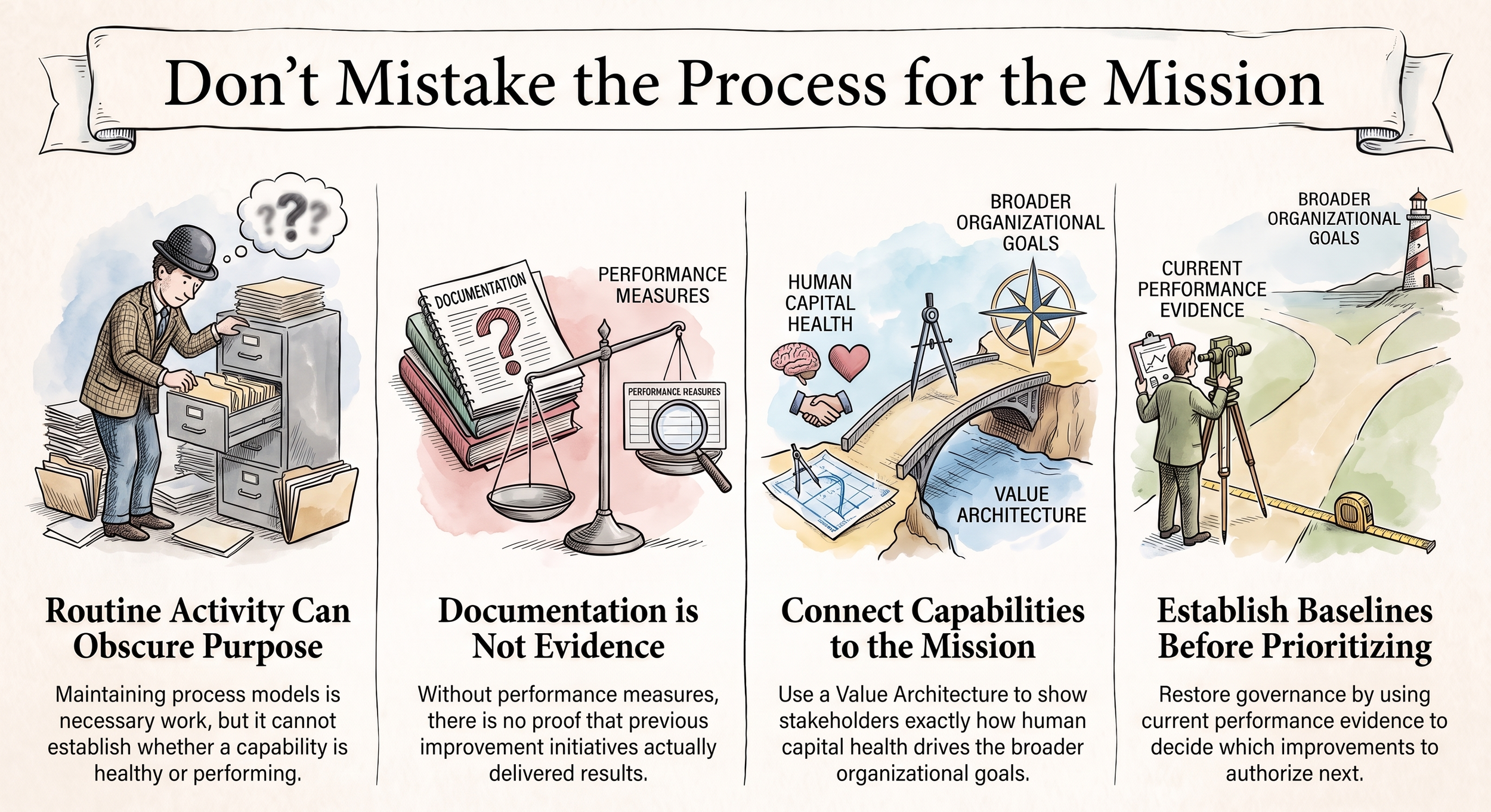
An illustrated infographic showing the importance of measuring performance and connecting organizational capabilities to mission outcomes.
Recovering the Purpose of a Human Capital Management Program
Primary relevance: Capability Health Assessment
Related capabilities: Value Architecture, Transformation Roadmap, capability management, governance, and performance measurement
Drawn from engagement work performed by i3SCF’s founder. Client and identifying details have been anonymized. A human capital management function had concentrated its attention on updating business process models after roughly two years without sustained model maintenance. Historical plans told a larger story: the function existed to establish, maintain, assess, and modernize the business capabilities supporting human capital management.
The engagement recovered that purpose, conducted a capability health assessment, and rebuilt the strategic basis for improvement. It delivered a Value Architecture and a Transformation Plan that stakeholders received positively and requested access to. The contract ended before the recommendations could be implemented through the engagement.
Challenge
The immediate pressure was tangible: process models needed updating, and the working focus was on recovering the previous architecture. That work mattered. But completing the documentation would leave a more consequential question unanswered:
Which capabilities needed attention, and on what evidence would the program decide?
The function’s broader responsibilities had receded from operational attention. Its historical Transformation Plans contained approximately ten years of activity, yet the strategic purpose behind that activity had become difficult to see.
What We Found
Reviewing the historical record exposed gaps beyond the model-maintenance backlog:
Capability priorities were about a decade old.
The earlier prioritization could not establish which capabilities currently needed improvement.
Governance had stopped functioning.
The existing board’s focus had drifted from its original role in determining which improvement initiatives should be authorized and established.
Results could not be demonstrated from t e measures found.
The review located no documented performance measures showing whether prior initiatives had achieved their intended improvements. This was an evidence gap; it did not establish that those initiatives had failed.
The planning document had lost its strategic usefulness.
At roughly 100 pages, the Transformation Plan had accumulated historical, analytical, and technical material that obscured its purpose as a roadmap for improvement.
Taken together, these findings indicated that the function’s activity had narrowed substantially from its intended capability-management and modernization role.
Turning Point: Recover the Purpose Behind the Work
The decisive move was to return to the historical plans and separate the function’s original mandate from the accumulated detail. That changed the question guiding the work. Updating models was one responsibility within a larger cycle: understand capability health, identify gaps, determine priorities, authorize improvement, and assess the results.
A current process model could describe the work. It could not, by itself, establish whether the capability was healthy or whether an earlier intervention had improved performance.
This insight put performance measurement and governance at the center of the recommendations. Reprioritization needed a current evidentiary basis, and improvement initiatives needed a functioning decision body.
What We Did
The work began by reconstructing strategic intent from approximately ten years of Transformation Plans. It traced the purpose of the human capital management capabilities to the broader organizational mission and examined the gap between the function’s intended responsibilities and its observed operating focus. A capability health assessment identified weaknesses in capability management, governance, and the evidence available to judge performance. The assessment did not establish a quantified performance baseline; creating that baseline became a central recommendation.
A Value Architecture then made the strategic relationships visible. It served as a stakeholder orientation tool, explaining why maintaining and modernizing human capital capabilities mattered to the organization’s mission.
The Transformation Plan was rebuilt around its original purpose: a strategic roadmap for identifying improvement opportunities, recommending how to prioritize them, and guiding subsequent execution. The work shifted the document’s emphasis from preserving accumulated material to supporting decisions about what should happen next.
Deliverables
Capability health assessment: A diagnosis of the function’s condition and the gaps affecting its ability to manage and modernize capabilities.
Value Architecture: An orientation tool connecting human capital capabilities to organizational purpose.
Rebuilt Transformation Plan: A strategic roadmap incorporating recommendations for performance measurement, capability reprioritization, and restoration of the existing governance mechanism.
Observable Results
The Value Architecture and Transformation Plan were presented to stakeholders in two approximately 30-minute presentations. Stakeholders responded positively and requested access to the materials.
The engagement produced a documented diagnosis, an explanation of the connection between capability health and mission, and a roadmap for restoring the function’s broader purpose. Stakeholder response demonstrated interest in the work; it did not establish formal adoption or implementation.
Governance restoration, measurement system implementation, modernization initiatives, and post-intervention measurement were not executed by the engagement.
Recommendations / Next Steps
Establish a Performance Measurement Baseline before reprioritizing capabilities, so decisions could draw on current performance evidence.
Restore the existing governance board to its original role, reconnecting capability needs with decisions about which improvement initiatives to authorize and establish.
Use the rebuilt Transformation Plan to guide improvement, moving from identified gaps to evidence-informed priorities and authorized execution.
Measure performance after intervention to determine whether the resulting changes improved capability health and performance.
These were recommendations for subsequent execution, not completed implementation outcomes.
Why It Matters
A function can remain occupied with legitimate work while losing sight of the larger responsibility that work supports. Here, the process-model backlog was visible. The missing links between capability health, performance evidence, governance, and modernization required a broader assessment.
This case provides practical evidence for i3SCF’s Capability Health Assessment: recover the intended purpose, examine the operating reality, and identify what needs attention. It also demonstrates how Value Architecture and a Transformation Roadmap can help stakeholders understand the findings and determine a path forward.
The transferable lesson is straightforward: before accelerating the work already in motion, establish whether it still serves the function’s intended purpose—and how improvement will be demonstrated.