
Organizing Around the Work: From Capabilities to Accountability
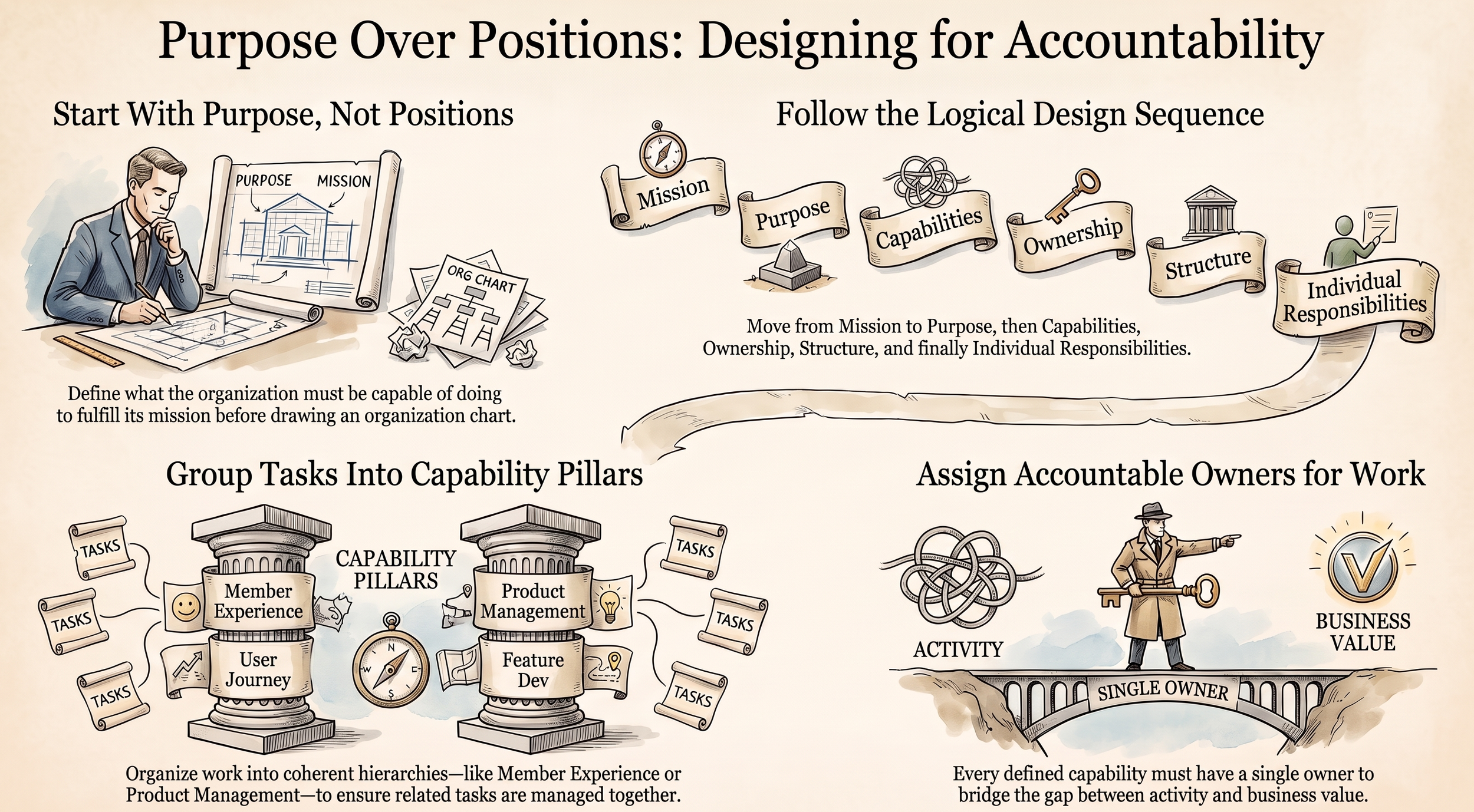
An illustrated framework showing how organizations can design for accountability by starting with mission and purpose, grouping work into capabilities, assigning clear ownership, and then aligning structure and individual responsibilities.
When a Dental Program Needs Organizational Redesign
Primary Relevance: Organizational Engineering
Related Capabilities: Business & Enterprise Transformation; Capability Assessment & Management; Operating Model Modernization; Organizational Design & Alignment; Governance & Accountability; Performance Management; Strategic Alignment
Drawn from engagement work performed by i3SCF’s founder. Client and identifying details have been anonymized.
Transformation often begins with a familiar question:
How should the organization be structured?
But starting with the organization chart can lead to the wrong answer. A better question is:
What does the organization need to be capable of doing to fulfil its purpose?
That distinction became important during an informal advisory effort supporting the director of a major health insurance product program undergoing significant transformation.
The Challenge
The program was operating in an environment where customer value had not consistently driven organizational decisions. The business had experienced an estimated 60% loss in market share, while several existing practices generated considerable activity without corresponding business value. Responsibilities were not always aligned with the skills required to perform them, reporting activities did not consistently provide useful management information, and the organizational structure did not clearly reflect accountability for the work.
The Program Director had begun a broader transformation intended to improve product performance, strengthen customer focus, modernize legacy practices, and establish clearer accountability. Modernization initiatives implemented as part of that broader transformation generated approximately $10 million in estimated cost savings.
But another problem remained:
How should the organization itself be structured to support the transformation?
Start With Purpose, Not Positions
The answer did not begin with moving positions around an organization chart. It began with the enterprise mission and vision. Before determining who should report to whom, the program needed to understand how its work contributed to the broader organization's purpose. That established a logical sequence:
Enterprise Mission & Vision → Program Purpose → Capabilities → Capability Ownership → Organizational Structure → Individual Responsibilities
This changed the conversation. Instead of asking where existing employees belonged, the program could first determine what capabilities were necessary to accomplish its objectives and then establish accountability for those capabilities.
Building the Capability Structure
An existing inventory of program capabilities provided a starting point, but the capabilities needed to be reorganized into a coherent hierarchy. The inventory was restructured into parent-child relationships so related capabilities could be grouped and managed together. At the highest level, the capability structure addressed areas including:
Dental Product Management
Program Management & Governance
Performance & Business Management
Partner & Stakeholder Management
Market & Member Growth
Member Experience & Retention
The purpose was not simply to create a cleaner taxonomy. Each capability needed an accountable owner. Once ownership was established, the capability model became a tool for organizational design.
Designing the Organization Around Accountability
The existing organization contained six positions, but its reporting relationships did not cleanly correspond to the work being performed. Rather than preserving the existing structure and simply redistributing tasks within it, the organization was redesigned around capability ownership.
The Program Director retained accountability for Dental Product Management, Program Management & Governance, and Performance & Business Management.
The Product Manager assumed responsibility for Partner & Stakeholder Management and Market & Member Growth, aligning responsibility for product development, marketing, growth, and external relationships.
The Member Experience Manager assumed responsibility for Member Experience & Retention, creating clear management accountability for the member relationship and experience.
The remaining staff positions could then be aligned beneath the Product Manager and Member Experience Manager according to the capabilities and responsibilities they supported.
The resulting structure established a clearer connection between what the program needed to accomplish, who was accountable for accomplishing it, and how the workforce should be organized to execute the work.
From Design To Implementation
The organizational design was not left as a conceptual recommendation. The Program Director took the redesigned structure forward for executive consideration. It received CEO approval and was subsequently implemented. Because implementation is recent, it is too early to credibly attribute changes in membership growth, retention, customer satisfaction, or other product-performance measures to the organizational redesign itself. Those outcomes require time and evidence. The immediate result is more concrete: the program moved from an organizational structure that did not clearly reflect its work to one explicitly aligned around capabilities, ownership, and accountability.
The Broader Lesson
Organizational design should not begin with boxes and reporting lines. An organization exists to perform work that contributes to a larger purpose. Its structure should reflect that. Starting with mission and capabilities creates a different sequence of decisions:
Why do we exist?
What must we be capable of doing?
Who should be accountable for those capabilities?
What responsibilities and work sit underneath them?
Only then: How should we organize the people?
That approach turns the organization chart into an output of organizational design rather than the starting point. When transformation requires changing how an organization performs, that distinction matters.